The Antinomies of Realism by Fredric Jameson
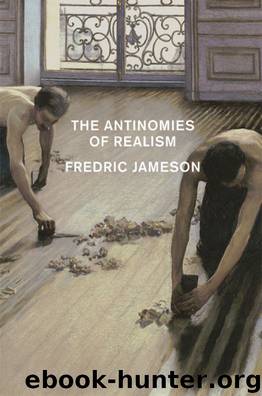
Author:Fredric Jameson
Language: eng
Format: epub
Publisher: Verso Books
Published: 2013-10-08T04:00:00+00:00
Now this is an opening sentence, and thereby all the more significant insofar as it programs the reader and proposes a certain narrative and ultimately novelistic stance on what follows. But if this is so, and if “the novel” is at one and the same time Barthes’ “novelistic” and the last genre to be dissolved in realism’s struggle against reification and reified form, then it becomes paradoxically clear that realism’s ultimate adversary will be the realistic novel itself.
1 One notes in Spain, particularly after 1898, the emergence of all kinds of “philosophies of the Quijote” (Ortega, Unamuno) and evocations of the “Cervantine,” in which even the shape of the master’s sentences project a whole Lebensphilosophie: I know of nothing comparable in any other nation’s literature. Meanwhile, it would be ill-advised to underestimate Cervantes’s literary impact down through the ages: all of Galdós, for example, is suffused with the fundamental themes of the Quijote.
2 Michael Fried, Absorption and Theatricality, Chicago: University of Chicago Press, 1988. We should also note the implications of this position for modernism (Fried, Art and Objecthood: Essays and Reviews, Chicago: University of Chicago Press, 1998) as well as its return in unexpected contemporary practices such as that of photography (Fried, Why Photography Matters as Art as Never Before, New Haven: Yale University Press, 2008).
3 The classic work on the meaning of melodrama is that of Peter Brooks, The Melodramatic Imagination, New Haven: Yale University Press, 1995.
4 Here, the inaugural text is that of Thomas Elsaesser, “Tales of Sound and Fury,” in Movies and Methods, Volume II, ed. Bill Nichols, Berkeley: University of California Press, 1985.
5 Erich Auerbach, Literary Language and its Public in Late Latin Antiquity, New York: Pantheon, 1965.
6 Erich Auerbach, “On the Serious Imitation of the Everyday,” in Flaubert, Madame Bovary, Norton Critical Editions, ed. Margaret Cohen, New York: Norton, 2005.
7 Ibid., 427.
8 Northrop Frye, The Anatomy of Criticism, Princeton: Princeton University Press, 1957, 33–4.
9 René Girard’s “mimetic desire” (Desire, Deceit and the Novel, Baltimore: Johns Hopkins University Press, 1976) is only the most striking exemplification of this kind of theory, of which simulacrum theory and spectacle-society theory develop other aspects.
10 With Duranty and the supporters of painters like Courbet.
11 See Georg Lukács, Writer and Critic, London: Merlin, 1970; and Studies in European Realism, London: Merlin, 1972. It is important to add that for Lukács, the “typical” was what ultimately registered the subterranean movements of History itself and not the merely stereotypical.
12 Franco Moretti, The Way of the World, London: Verso, 2000.
13 See “The Experiments of Time” in this volume.
14 See note 11 above, as well as Lukács, The Historical Novel, Lincoln: University of Nebraska Press, 1983.
15 I hope the lamentable absence of any discussion of Balzac in the present work will be remedied by a reminder of the two chapters of my The Political Unconscious (Ithaca: Cornell University Press, 1981) on La Cousine Bette and La Rabouilleuse (The Black Sheep), respectively.
16 But see “The Historical Novel Today,” below, as well as Perry Anderson’s provocative
Download
This site does not store any files on its server. We only index and link to content provided by other sites. Please contact the content providers to delete copyright contents if any and email us, we'll remove relevant links or contents immediately.
4 3 2 1: A Novel by Paul Auster(12400)
The handmaid's tale by Margaret Atwood(7771)
Giovanni's Room by James Baldwin(7352)
Big Magic: Creative Living Beyond Fear by Elizabeth Gilbert(5780)
Asking the Right Questions: A Guide to Critical Thinking by M. Neil Browne & Stuart M. Keeley(5778)
Ego Is the Enemy by Ryan Holiday(5455)
The Body: A Guide for Occupants by Bill Bryson(5103)
On Writing A Memoir of the Craft by Stephen King(4948)
Ken Follett - World without end by Ken Follett(4738)
Adulting by Kelly Williams Brown(4581)
Bluets by Maggie Nelson(4562)
Eat That Frog! by Brian Tracy(4543)
Guilty Pleasures by Laurell K Hamilton(4453)
The Poetry of Pablo Neruda by Pablo Neruda(4112)
Alive: The Story of the Andes Survivors by Piers Paul Read(4037)
White Noise - A Novel by Don DeLillo(4015)
Fingerprints of the Gods by Graham Hancock(4007)
The Book of Joy by Dalai Lama(3993)
The Bookshop by Penelope Fitzgerald(3855)
